Introduction
Kenya’s blue economy represents untapped potential worth billions of shillings. While most discussions focus on fishing and maritime trade, a quieter revolution is happening: the integration of marine resources into sustainable agriculture. SeaVentures stands at the intersection of these two critical sectors.
Understanding Kenya’s Blue Economy
The blue economy encompasses:
- Marine fisheries (estimated 300,000 tonnes annual potential)
- Aquaculture (growing 15% annually)
- Coastal tourism
- Maritime transport
- Marine biotechnology
- Waste-to-value innovations (our focus)
Kenya’s 600km coastline and Exclusive Economic Zone (EEZ) offer enormous opportunities beyond traditional fishing.
The Agriculture-Ocean Connection
Most people don’t realize how deeply connected farming and fishing are:
Historical Context:
- Coastal communities have always used fish waste as fertilizer
- Traditional farmers near lakes used fish for soil enrichment
- Marine minerals have supported agriculture for centuries
Modern Innovation:
- Fish protein feeds for livestock and aquaculture
- Marine-based organic fertilizers
- Seaweed extracts for crop enhancement
- Aquaponics (fish + plant farming)
Why This Matters for Kenya
Food Security Challenge:
- Kenya needs to feed 50+ million people
- Agricultural productivity must increase 50% by 2030
- Protein deficiency affects 35% of rural populations
- Livestock feed costs consume 60-70% of production expenses
Environmental Pressures:
- Overfishing threatens marine ecosystems
- Agricultural runoff pollutes water sources
- Chemical fertilizers degrade soil health
- Waste management challenges in coastal areas
The Circular Solution:
SeaVentures’ model addresses multiple challenges:
1. Reduces Ocean Pollution
- Diverts 60-70% of fish waste from ocean dumping
- Currently prevents 10+ tonnes monthly from coastal pollution
- Scaling to handle 100+ tonnes by 2027
2. Supports Sustainable Farming
- Provides affordable, high-quality feed alternatives
- Reduces dependence on imported feed ingredients
- Lowers farmer production costs by 15-25%
3. Empowers Coastal Communities
- Creates income for fishermen beyond catch sales
- Employs women and youth in collection and processing
- Builds economic resilience in vulnerable communities
4. Improves Livestock Productivity
- Higher protein content than traditional feeds
- Better animal health and growth rates
- Superior product quality (meat, eggs, milk)
Blue Economy Success Stories
Case Study 1: Mombasa Fish Farmers Cooperative
- Switched to Zuri Fish Feeds in 2024
- Saw 20% improvement in growth rates
- Reduced total feed costs by 18%
- Now purchasing 2 tonnes monthly
Case Study 2: Kilifi Poultry Farm
- Integrated Zuri Poultry Feed in laying hen rations
- Egg production increased 12%
- Shell quality improved significantly
- Customer demand increased due to better taste
Case Study 3: Community Impact in Kwa-le
- 30 women traders now supply fish waste
- Average monthly income increased by KES 3,500 per person
- Reduced beach pollution by 80%
- Created processing jobs for 15 youth
Government Support & Policy
Kenya’s government recognizes blue economy potential:
Vision 2030:
- Blue economy identified as key growth sector
- Target: KES 10 billion from marine resources by 2030
Policy Frameworks:
- Kenya Marine and Fisheries Research Institute (KMFRI) research support
- Beach Management Units (BMUs) formalized
- Coastal and Marine Bill supporting sustainable use
National & County Support:
- County governments offering SME grants
- National programs supporting agribusiness innovation
- Research institution partnerships
Challenges & Solutions
Challenge 1: Awareness
- Many farmers don’t know about fish-based feeds
- Solution: Educational outreach, demonstration farms, testimonials
Challenge 2: Perception
- “Fish waste” sounds unappealing
- Solution: Rebrand as “marine protein”, emphasize quality testing
Challenge 3: Scaling Production
- Limited processing capacity
- Solution: Investment in equipment, facility expansion
Challenge 4: Seasonality
- Fish waste availability varies
- Solution: Storage systems, diverse sourcing, preservation methods
The Path Forward
Short-term (2026-2027):
- Scale production to 20 tonnes/month
- Expand to upcountry markets
- Launch organic fertilizer line
- Achieve KEBS certification
Medium-term (2027-2029):
- Establish regional distribution network
- Partner with agricultural cooperatives
- Export to East Africa
- Develop premium product lines
Long-term (2030+):
- Become East Africa’s leading sustainable feed producer
- Franchise model for coastal processing
- International markets
- Blueprint for other developing nations
How You Can Participate
As a Farmer:
- Try Zuri Feeds for your livestock
- Share results with your community
- Join our demo farm network
As a Fisherman/Trader:
- Partner with us to supply fish waste
- Earn extra income
- Support environmental conservation
As an Investor/Partner:
- Explore collaboration opportunities
- Support scaling and expansion
- Join Kenya’s blue economy revolution
As a Consumer:
- Choose products from farms using sustainable feeds
- Support circular economy businesses
- Spread awareness
Conclusion
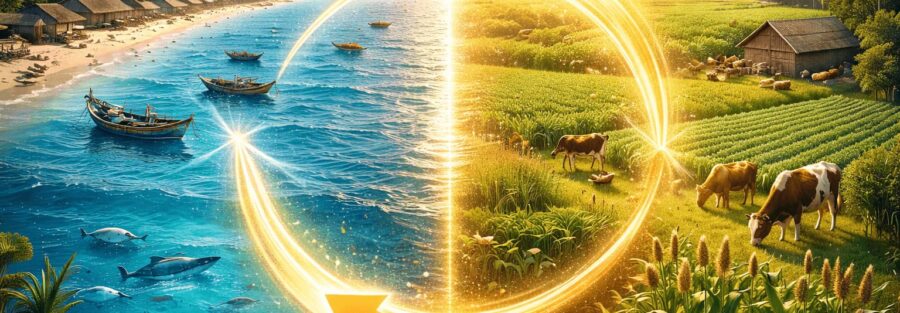
Kenya’s blue economy isn’t just about fishing—it’s about reimagining how we use ocean resources to feed our nation sustainably. SeaVentures proves that waste isn’t waste; it’s opportunity. By connecting the ocean to the farm, we’re building a more sustainable, prosperous future for Kenya.
The revolution is happening now. Join us.